
Criminal Cases in the Taylor County Courts
Taylor County does not split local criminal matters among separate felony, misdemeanor, and municipal court databases. The Iowa District Court has general trial jurisdiction. It hears felonies and indictable misdemeanors, while judicial magistrates handle many simple misdemeanors, initial appearances, and preliminary matters. A case filed from Bedford, Lenox, New Market, or another Taylor community therefore enters the same state court structure. The county attorney may file a complaint, trial information, or other charging paper, but the prosecutor is not the public file custodian.
The Taylor County Clerk of District Court keeps the docket and filed record at 405 Jefferson Street, Suite 4, Bedford, IA 50833. The office phone is 712-523-2095. The clerk can answer docket questions and provide public pleadings, plain copies, or certified copies that are not available as online images.
The county's official clerk page shows the local route to Taylor County court records.
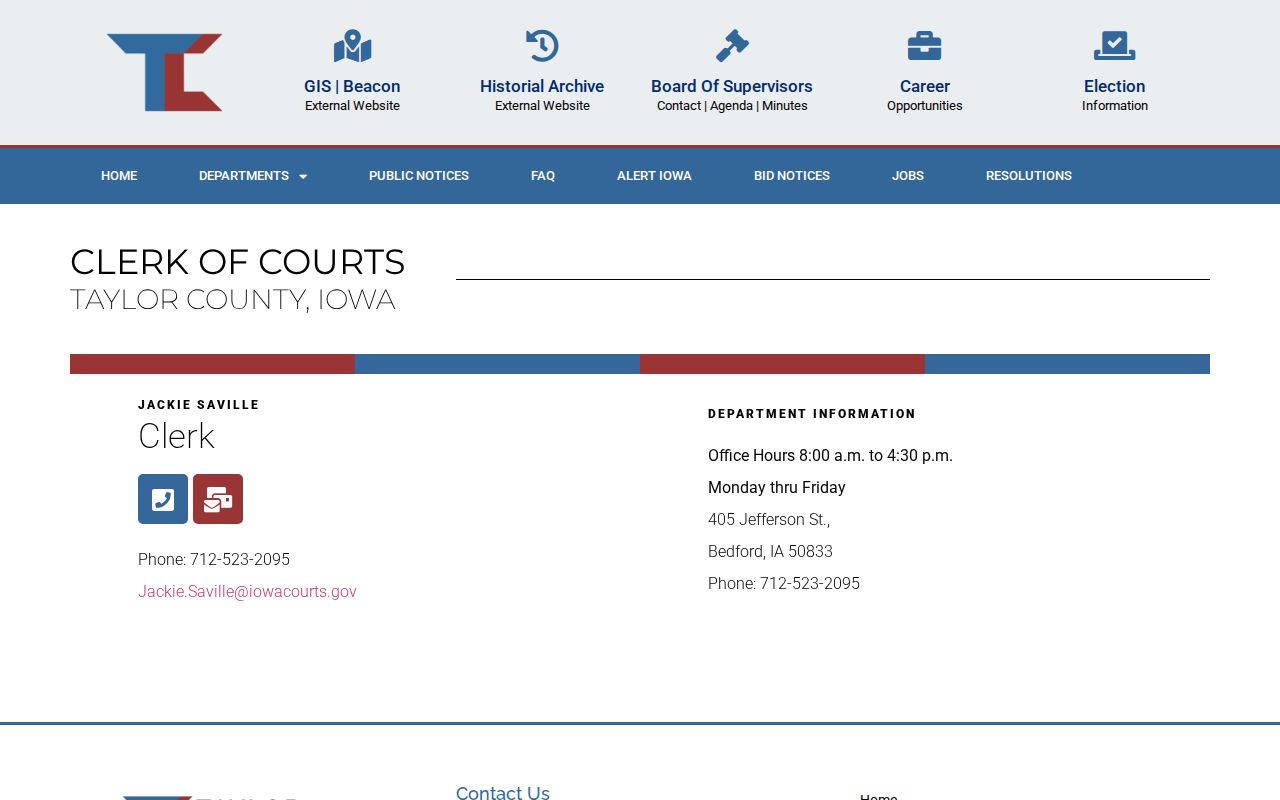
That local entry point matters when a docket result must be backed by the actual filed paper or a certified disposition.
Searching Taylor County Court Cases Online
Iowa Courts Online is the main statewide index for Taylor County criminal case records. Basic docket access is free. Search by an exact case number when one is known. Otherwise, use the legal name and choose Taylor County where the interface allows. A middle name, filing period, and case type can help separate similar names. Do not merge two results merely because the first and last names match.
The public view can expose the county, case ID, filing date, status, party roles, charges, Iowa Code sections, offense class, hearing dates, docket events, financial entries, and count-level dispositions. It is a finding aid, not the full court jacket. Images of pleadings are not promised. A result marked “disposed” means the matter reached an outcome. It does not, by itself, mean the person was convicted.
The basic search screen is the source for the statewide Taylor County case lookup.
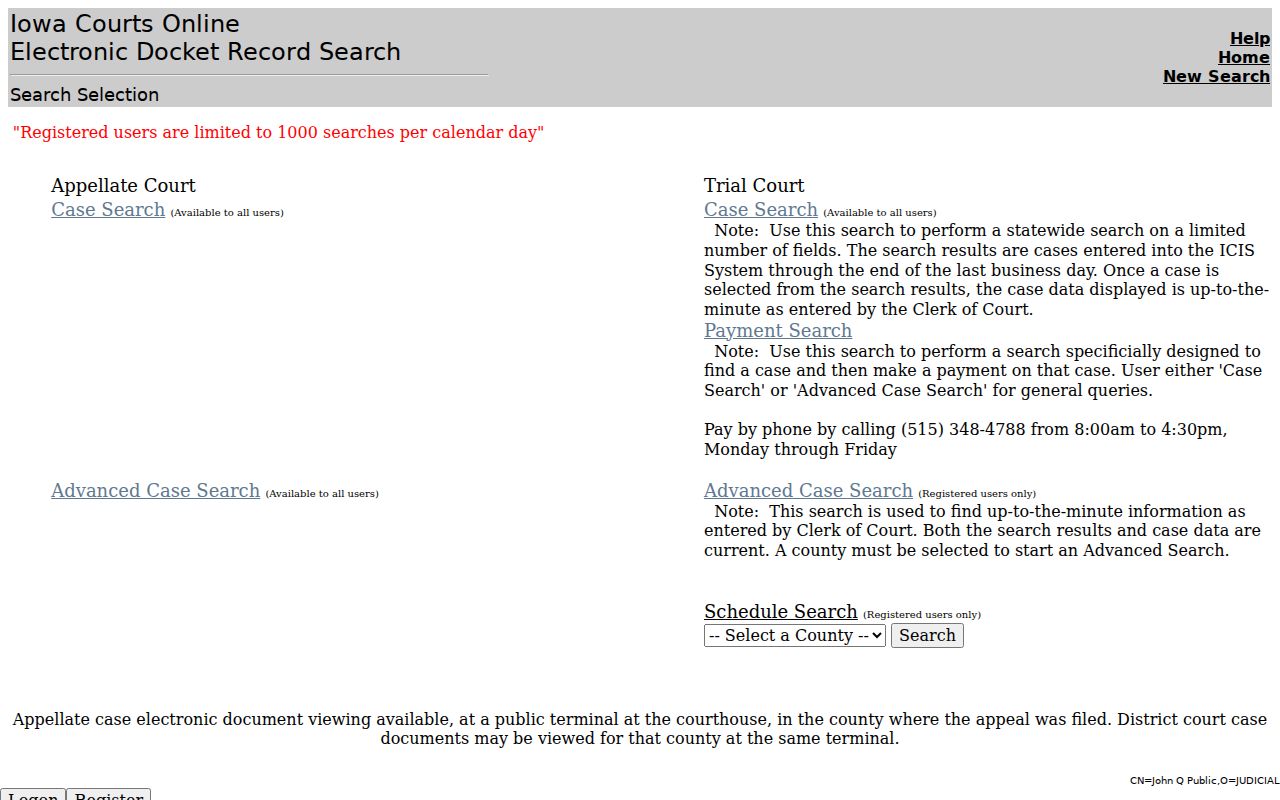
The county filter and case-number route help prevent a Taylor search from drifting into another Iowa jurisdiction.
How to Search Case Records
A careful Taylor County criminal case search moves from the statewide index to the local clerk. Keep the case ID with every note. The charge at booking can change before the prosecutor files, and one case may contain several counts with different outcomes. Read each count rather than relying on a broad case status.
- Open Iowa Courts Online and select the trial court case-search route.
- Use the complete case number if available, or search the party name and narrow the county to Taylor.
- Compare the middle name, filing date, case type, and other public facts before treating a result as a match.
- Open the docket and record each charge, statute, offense class, event, and count-level disposition.
- Call or visit the Taylor County clerk for the named pleading, judgment, or certified disposition.
| Field Label | Type | Required | Notes |
|---|---|---|---|
| Trial Court / Case Search | Navigation | Yes | Use trial court rather than appellate search or payment. |
| Last Name | Text | Name route | Spelling matters; use the legal surname. |
| First and Middle Name | Text | No | These fields narrow common-name results. |
| County | Dropdown | No | Select Taylor for local criminal cases. |
| Case ID / Case Number | Text | Alternative | This is the most exact route. |
| Case Type / Date Range | Advanced controls | No | Use them to narrow docket or schedule results. |
Note: Iowa Courts Online may post a docket before all documents are available for inspection at the Taylor County clerk's counter.
Taylor County Advanced Case Search Limits
The paid Advanced Case Search adds broader party details, schedules, case types, exhibit lists, returns of service, judgments, liens, and more complete financial information. The subscription costs $25 per month. It still does not supply filed-document images or let a user pay court costs. Taylor County pleadings and certified records remain a clerk request.
The advanced login page identifies the subscription route.
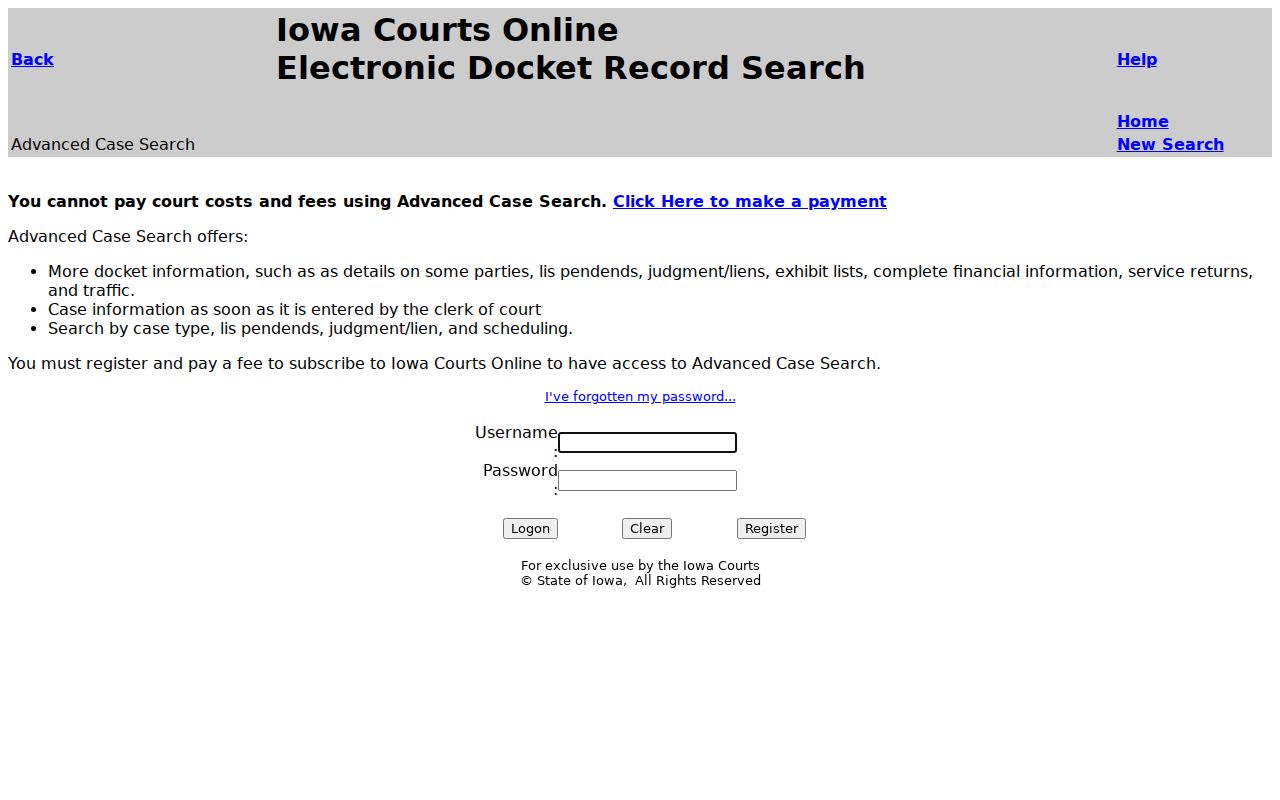
The login expands data filters, but it does not turn the public docket into a document repository.
Registration asks for a user ID, a compliant password, a security question and answer, card details, name, email, and the number of subscription months. Because the fields and terms can change, rely on the live screen rather than a saved list.
The official registration screen states the current Taylor County advanced-search terms.
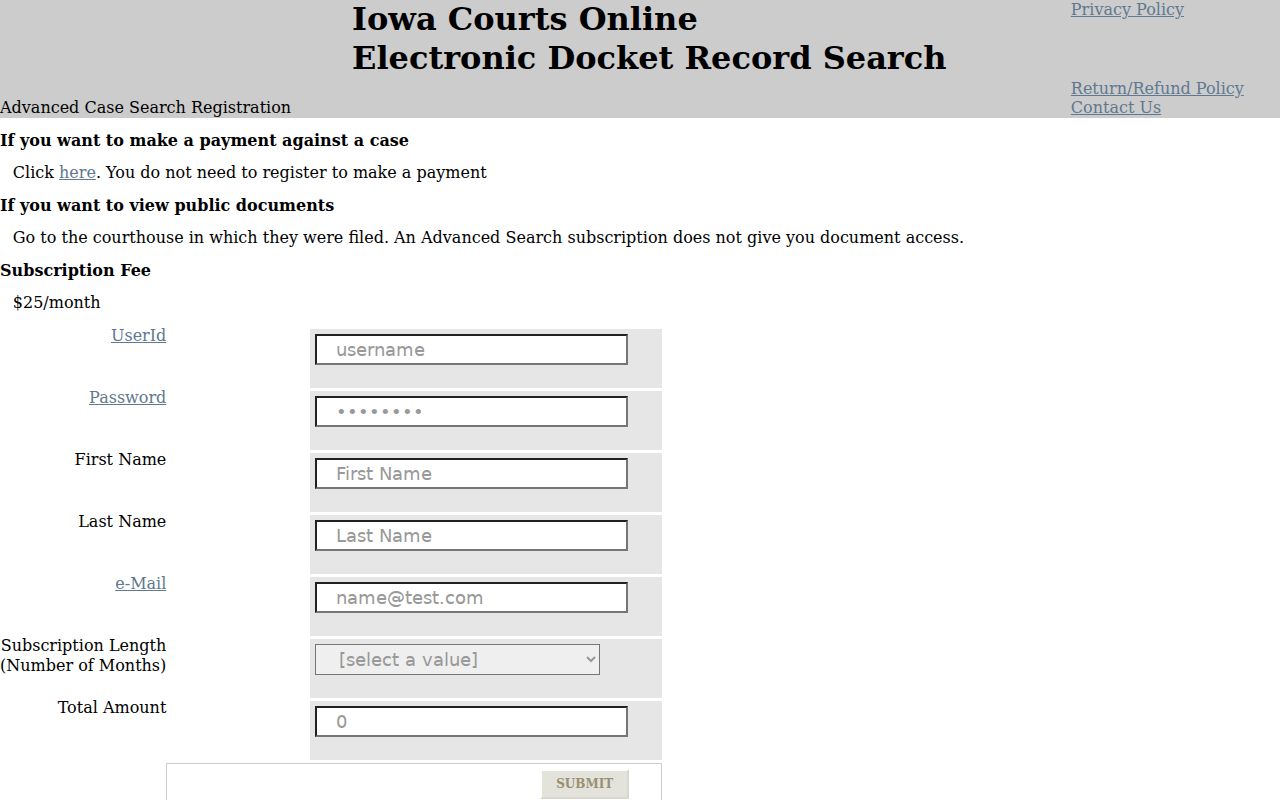
The registration image also reinforces the key limit: public documents must be obtained at the courthouse where they were filed.
What the Case File Shows
A Taylor County court file follows the charge after it reaches the Judicial Branch. It may contain a complaint, initial-appearance papers, bond orders, counsel entries, trial information, a written arraignment, motions, plea papers, judgment, sentencing orders, restitution or financial entries, probation terms, warrant events that are public, and appeal notices. The useful document depends on the question. A charging paper shows what was filed; the judgment and disposition show how each count ended.
| Case Number & Court | The Taylor County case identifier, court, case type, filing date, and status. |
|---|---|
| Charging Document | The complaint, trial information, indictment when used, or an amended count. |
| Docket Entries | A dated register of filings, hearings, orders, pleas, and other court events. |
| Hearing Dates | Public dates and times for appearances, conferences, trial, or sentencing. |
| Disposition & Judgment | The outcome for each count, which may be conviction, dismissal, or acquittal. |
| Sentence & Conditions | Jail or prison terms, probation, fines, restitution, and other court orders. |
The court file answers what the prosecutor filed and what the judge did. The Taylor County arrest history route is separate because the arresting agency and jail create those earlier records.
Taylor County Court Terms in Plain Words
Iowa docket language can hide the real result if a reader treats each event as a final ruling. These common Taylor County criminal case terms mark different points in the process. Their placement and date often matter as much as the label.
- Trial information
- The prosecutor's formal charging document for many indictable Iowa offenses.
- Arraignment
- The stage when the accused is told the filed charge and enters a plea.
- Disposition
- The outcome of a charge or case, not a synonym for conviction.
- Mittimus
- A court order that commits a person to custody.
- Deferred judgment
- A judgment held back while court-ordered terms are completed, with specific confidentiality rules.
A “dismissed” count ended without a conviction on that count. A plea on another count can still produce a judgment in the same Taylor County file.
Stages of a Criminal Case
A Taylor County case can start with an arrest or summons, then move to a complaint and initial appearance. The court addresses bond or release terms. The county attorney decides whether and what to file. Indictable cases may proceed through trial information or an indictment, followed by arraignment, discovery, motions, plea talks, or trial. Judgment and sentencing come after a guilty plea or verdict. Posttrial motions, appeal, probation, county jail, or Iowa Department of Corrections custody may follow.
Case flow: Charges Filed › Arraignment › Pretrial › Plea or Trial › Disposition › Sentencing
The final count-level disposition deserves more weight than the first allegation. Taylor County booking labels may be reduced, amended, replaced, or dismissed as the case moves.
Thursday Taylor County Court Sessions
A current Fifth Judicial District order designates Taylor County magistrate time on Thursdays from 9:00 a.m. to 4:30 p.m., excluding legal holidays. That schedule is a local court detail, not a promise that every first appearance, hearing, or filing will occur in that window. Docket dates and direct clerk confirmation control for a specific case.
Magistrates handle many simple misdemeanors and preliminary matters within Iowa's unified District Court. Taylor County still does not gain a separate magistrate database. The same Iowa Courts Online search and the same Suite 4 clerk route apply. A person planning an in-person records visit should call first because department hours, hearing needs, accessibility arrangements, and file availability can differ.
Note: The Thursday designation is a local session schedule, not a universal deadline for initial appearances or new docket entries.
Access & Restrictions
Public Taylor County case records are available through judicial access rules, but not every item in a criminal file is open. Unexecuted arrest or search warrants, presentence reports, protected personal data, sealed juvenile matters, and certain deferred-judgment information may be absent or restricted. Victim-sensitive facts and identifiers can be redacted. A blank online result can also reflect a filing lag, a spelling issue, a confidential matter, or a search error.
Iowa Code chapter 22 governs many executive and local-government records, while court files are governed chiefly by Iowa Court Rules chapter 16 and related statutes. Send a sheriff report request to the sheriff, not the clerk. Ask the clerk for the filed Taylor County court record. The office can explain whether a public item must be inspected, copied, or certified, but it cannot disclose a confidential filing merely because the docket mentions it.
Taylor County is in the Central Division of the U.S. District Court for the Southern District of Iowa. Federal criminal cases do not appear in Iowa Courts Online. Search the federal docket through PACER or request an official public document from the federal clerk. A missing Taylor County state result says nothing about a case filed in another federal district.
Taylor County Dispositions at Suite 4
A certified disposition is the best local record when a Taylor County case outcome must be shown with official court proof. Start with the full case number and the exact count or document needed. Ask the clerk whether a plain copy is enough or whether certification is required for the reader's own purpose. The official Guide to Iowa's Court System has listed copies at $0.50 per page plus possible supervision or special-service costs, but a current Taylor County fee page was not found. Confirm the price before ordering.
Taylor County Clerk of District Court
405 Jefferson Street, Suite 4
Bedford, IA 50833
712-523-2095
General courthouse hours: Monday through Friday, 8:00 a.m. to 4:30 p.m.
If the final court result does not appear in a person's own Iowa DCI record, Iowa Code §692.5 supplies an access-and-challenge route. Obtain certified Taylor County proof first, then ask DCI to match the missing or incorrect disposition to the arrest cycle. Expunged, sealed, and confidential records follow their own access rules.