
How to Check Criminal History in Taylor County
Taylor County does not publish one database that contains every criminal record. Choose the custodian by asking what happened and how far the event moved. A recent custody question belongs with the Taylor County Sheriff and Jail. Once a charge is filed, Iowa Courts Online becomes the broad public index, while the Clerk of District Court supplies filed papers and certified dispositions. The Iowa Division of Criminal Investigation, or DCI, provides the state repository product. Iowa DOC covers disclosed prison and community-supervision status.
Gather a full legal name, spelling variants, an approximate date, and a case or report number when one is known. A name alone can join records from different people. Compare the county, middle name or initial, case dates, and exact case ID before treating two results as the same person. Use protected identifiers only through an official secure process.
- Call the Taylor County jail first for a very recent booking or custody check.
- Search Iowa Courts Online by name, then limit the county to Taylor when the control is available.
- Open each possible docket and compare the case number, filing date, charge, status, and disposition.
- Ask the Taylor County clerk for a public pleading or certified disposition that the online docket does not provide.
- Order the DCI check when the goal is a reportable statewide Iowa history rather than one Taylor County file.
Note: A no-result screen can reflect filing lag, restricted material, a spelling mismatch, or a record held by a different custodian.
Three Taylor County Record Offices
Three Bedford addresses explain much of the local record system. Court files are at the courthouse on Jefferson Street. Sheriff reports and Taylor County jail records are at the Justice Street complex. Probation and parole services operate from Main Street through Fifth Judicial District Community-Based Corrections. Asking one office for another office's file causes delay because these records have different creators and access rules.
| Taylor County office | Address and phone | Record role |
|---|---|---|
| Clerk of District Court | 405 Jefferson Street, Suite 4; 712-523-2095 | Filed cases, public pleadings, and certified dispositions |
| Sheriff Civil Division | 1601 Justice Street; 712-523-2153 | Sheriff reports, bookings, custody, and warrant questions |
| Fifth District Corrections | 402 Main Street; 712-523-2260 | Probation and parole operations |
The official Taylor County homepage shows the local government setting and office routes.
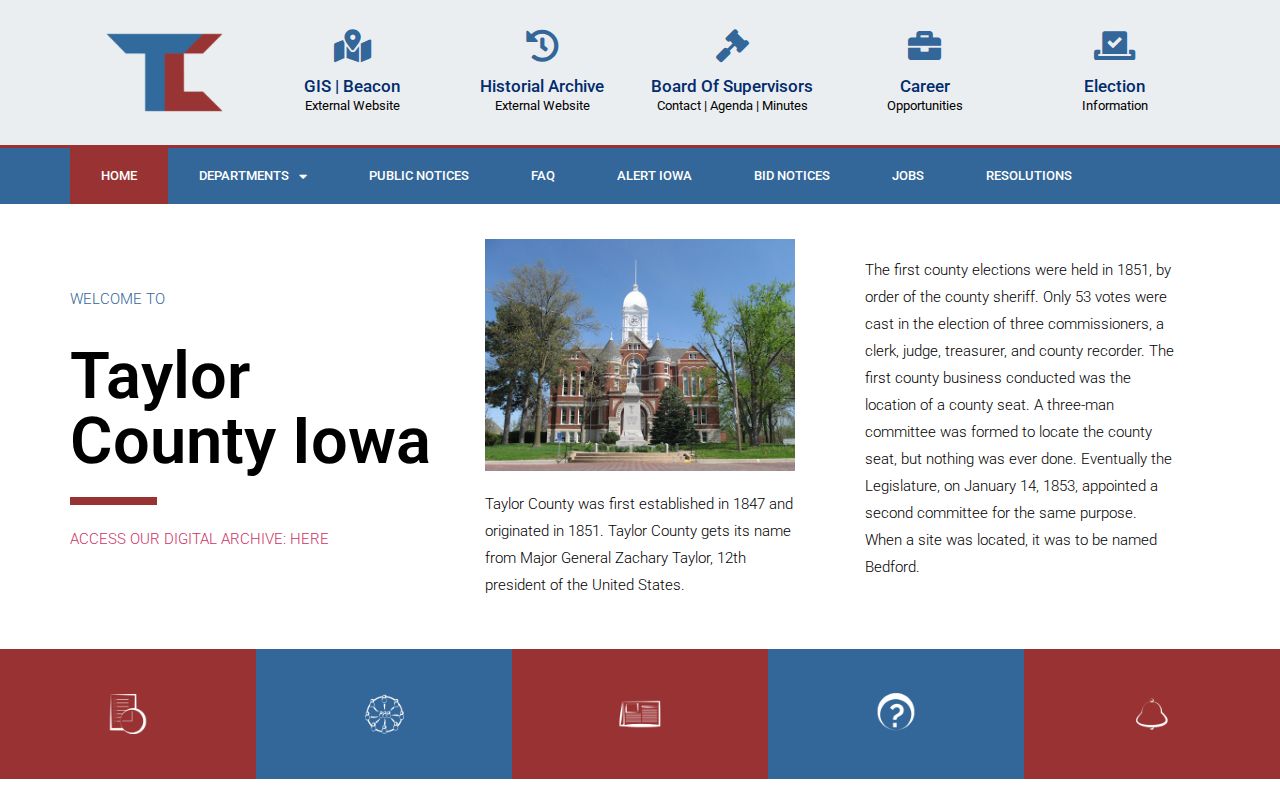
This county view is a starting point for readers, but the record itself still belongs to the clerk, sheriff, or corrections office named above.
The Taylor County Attorney works from Suite 6A in the courthouse and decides what state charges to prosecute. That office is not the keeper of the court file. Taylor and Ringgold counties approved a four-year shared elected county-attorney arrangement in 2025, a local change that can place one prosecutorial office across two counties without moving Taylor County pleadings out of the Bedford clerk's custody.
Official Iowa Background Checks
The Iowa Department of Public Safety, Division of Criminal Investigation, offers the official name-based state product through the Iowa Criminal History Record Check website. A request uses first name, last name, and date of birth. Middle name, sex, and Social Security number may help distinguish a match. Each subject search costs $15. The check is available online and through state forms, with in-person delivery at DCI in Des Moines.
The product is not a nationwide report. It draws on Iowa arrests reported to DCI, linked court dispositions, and custody data. It excludes other states, FBI information, and federal convictions. DCI also does not disseminate arrest information more than 18 months old when no final disposition is on file. A no-record response therefore means no matching releasable DCI record under the submitted data, not proof that no event exists anywhere.
The official Iowa DCI request portal is the direct online route for this state product.
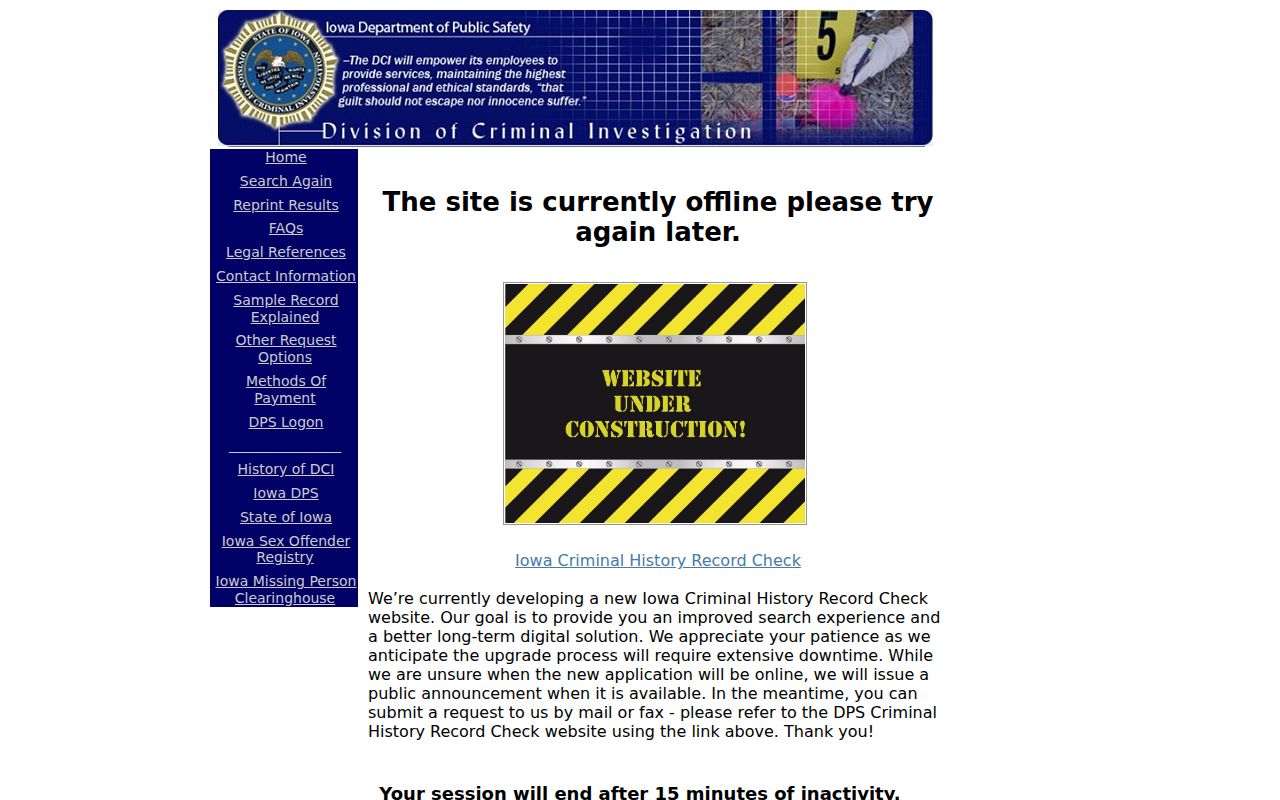
The portal screen shows why a DCI request is a separate step from searching a Taylor County court docket.
| DCI request field | Required | Use |
|---|---|---|
| First and last name | Yes | Core name-match fields |
| Date of birth | Yes | Required identity match |
| Middle name or aliases | No | Helps separate similar names |
| Sex and Social Security number | No | Optional identifiers used only through the secure official process |
| Signed release | Only for available deferred-judgment data | Authorizes that additional category when applicable |
Taylor County DCI Check Limits
DCI is useful when a Taylor County event has been reported and matched to a disposition, but the repository cannot replace the source file. The state's criminal-history request instructions describe the required inputs, price, delivery routes, and Iowa-only scope.
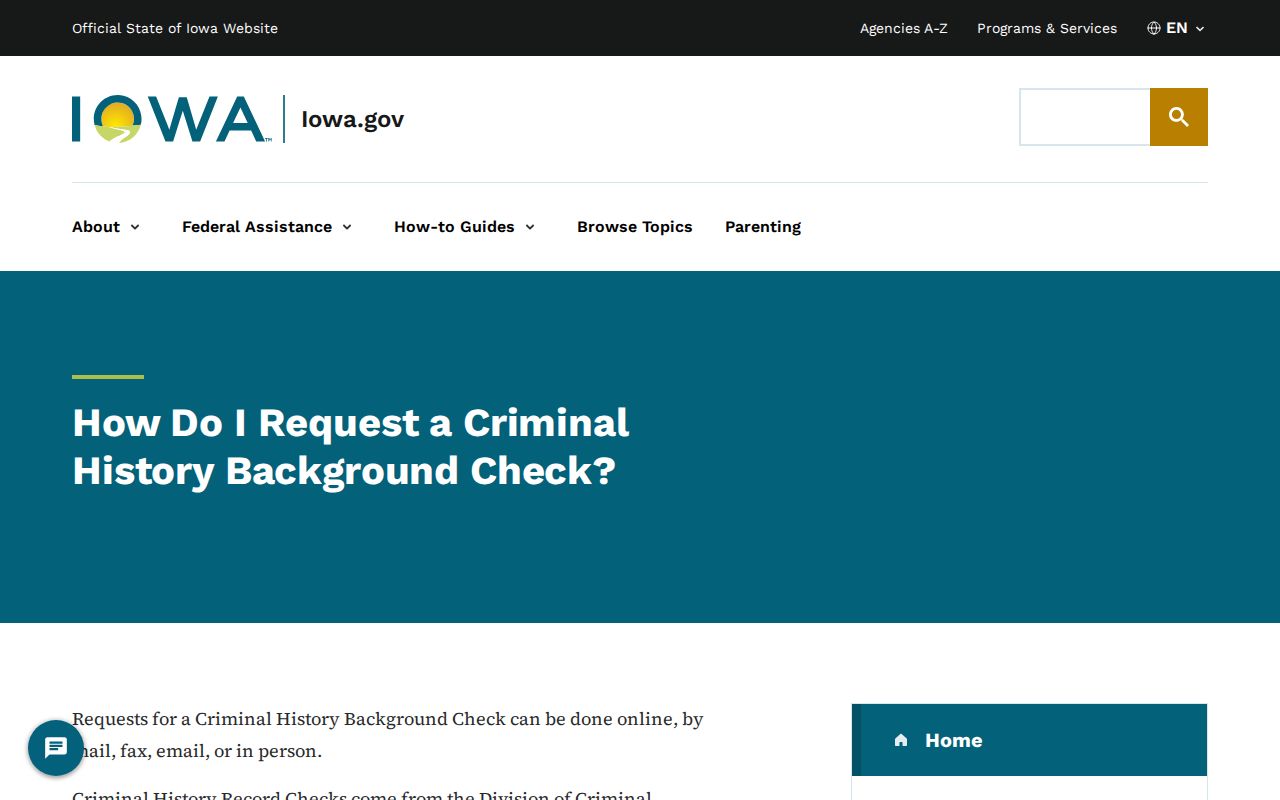
The instruction page helps a requester choose the state check while keeping its limits in view.
For a review of one's own nationwide identity history, the FBI uses fingerprints rather than a commercial name match. The FBI's Identity History Summary overview explains the subject-only product, and the Electronic Departmental Order portal is its online request route. Taylor County has not published a local fingerprint schedule or price. Call the sheriff before visiting to ask whether staff currently roll record-review cards, whether an appointment is needed, and whether the office accepts a supplied fingerprint card.
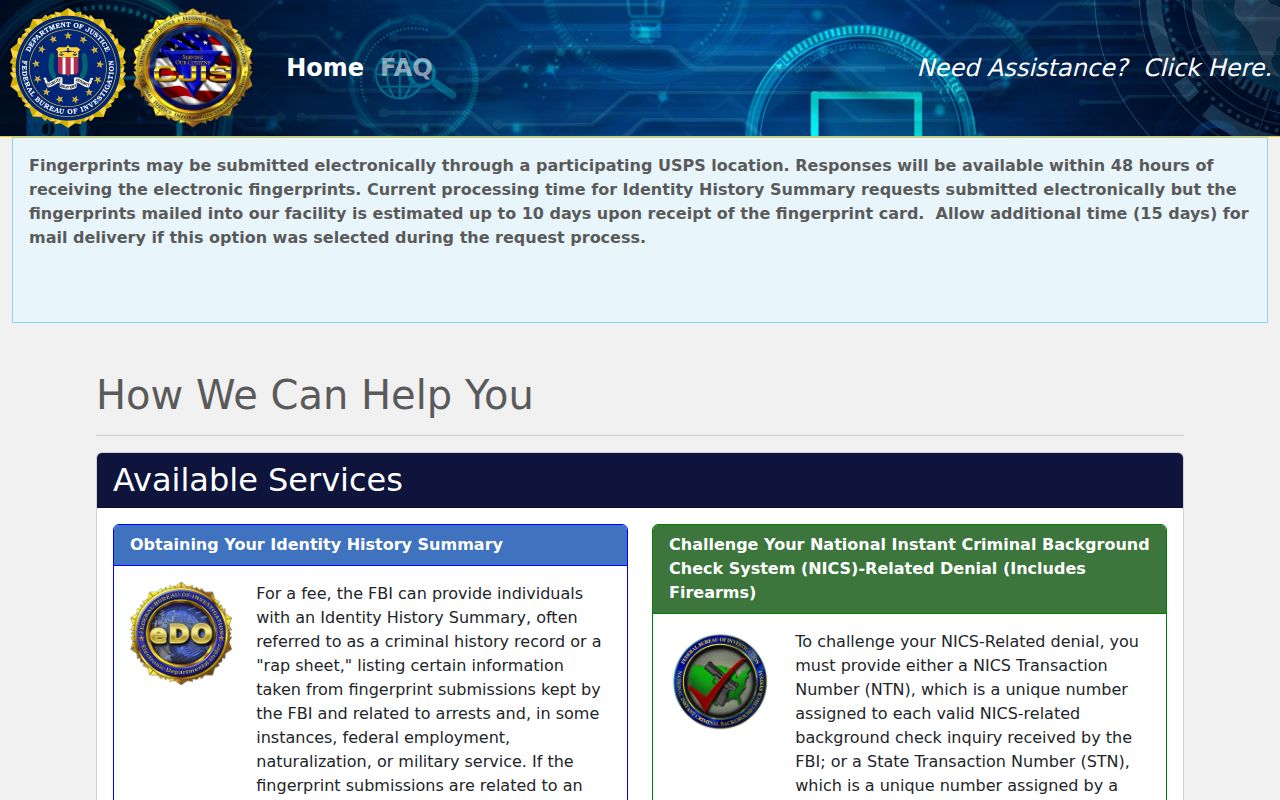
The federal portal is distinct from a Taylor County court search and from the Iowa DCI name-based product.
Types of Criminal Records
A Taylor County incident can produce several records, each answering a different question. The arresting officer's report explains the response and alleged basis for action. The jail booking sheet records intake and release facts. The county attorney's filed charge may differ from the holding allegation. The clerk's case file shows what the court did, and DCI may later connect the arrest cycle with its disposition.
- Incident and arrest report: agency narrative, event facts, alleged offenses, and releasable evidence details.
- Booking record: intake time, holding charges, bond, release or transfer, and jail identifiers.
- Criminal case file: complaints, trial information, motions, pleas, orders, judgment, sentence, and financial entries.
- Warrant record: a court command for arrest or search, which may remain confidential before execution.
- Custody or registry record: disclosed DOC status or fields made public through the Iowa Sex Offender Registry.
The court file supplies the full path from charge filing through judgment, while the arrest and booking files preserve the earlier agency view.
Taylor Arrest, Court, and Rap Sheets
These sources should not be treated as synonyms. Taylor County booking data answers whether the jail received a person and on which initial allegations. Court data answers what the prosecutor filed and how each count ended. A DCI history answers what reportable Iowa arrest cycles and dispositions are linked to the identity submitted.
- Disposition
- The outcome of a charge or case, such as dismissal, acquittal, deferred judgment, or conviction.
- Trial information
- An Iowa prosecutor's formal charging document for many indictable offenses.
- Deferred judgment
- A result in which judgment is deferred while court conditions are completed under specific Iowa rules.
- Mittimus
- A court order that commits a person to custody.
- Docket
- The dated register of filings, hearings, orders, and other case events.
A dismissal in the clerk's file does not always update an unmatched DCI arrest cycle at once. A person reviewing their own Taylor County record can obtain the certified disposition, then use Iowa Code section 692.5 procedures to challenge or correct repository data.
What a Taylor County Criminal Record Shows
The fields depend on the source. A public court docket may show party roles, a case ID, charges and statutes, filing dates, events, hearings, disposition, judge, financial assessments, and sentence data. A repository record is arranged around identity and arrest cycles. Protected identifiers, juvenile material, unexecuted warrants, presentence reports, and sealed or confidential records are not ordinary public fields.
| Name & Identifiers | Legal name, aliases, birth information at the allowed level, and agency or case identifiers. |
|---|---|
| Arrest / Booking Data | Arrest date, agency, booking time, initial allegation, bond, release, or transfer. |
| Charges & Statutes | Filed count, Iowa Code reference, offense class, amendments, and count-level detail. |
| Disposition | Dismissal, acquittal, deferred judgment, plea or verdict, with the outcome date when public. |
| Sentence | Jail or prison term, probation, restitution, fines, and other court conditions. |
| Custody / Supervision | Disclosed location, status, commitment county, release, or community-supervision information. |
Read the fields as a sequence, not as isolated labels. An early Taylor County charge can differ from the filed count, and the filed count can end in dismissal, acquittal, deferred judgment, or conviction.
No Taylor County Booking Log
No official online Taylor County inmate roster, current-booking list, arrest blotter, warrant app, or mugshot gallery was located. The correct Iowa route is the Taylor County Sheriff and Jail, not the similarly named sheriff website in Florida. Call 712-523-2153, give the full name and approximate date, and ask whether the person is held, released, or transferred. Then identify the arresting agency so the report request reaches the right office.
The Taylor County courthouse contact page confirms the Jefferson Street offices and general building hours.
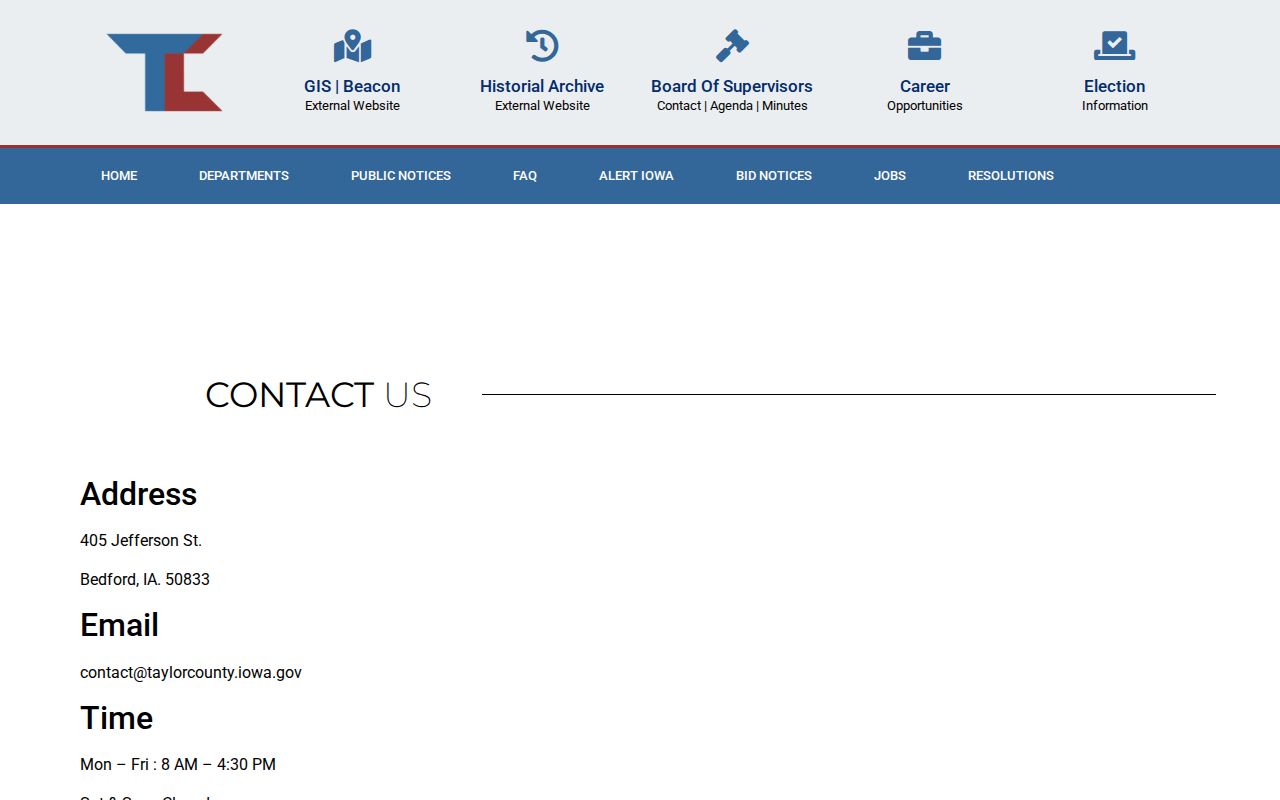
The county contact view helps separate courthouse services from the jail and sheriff records counter.
After filing, search the court docket. For a state prison or disclosed community-supervision record, use Iowa DOC Search Offenders. DOC says its public information is updated weekly, so it is not a live Taylor County jail roster.
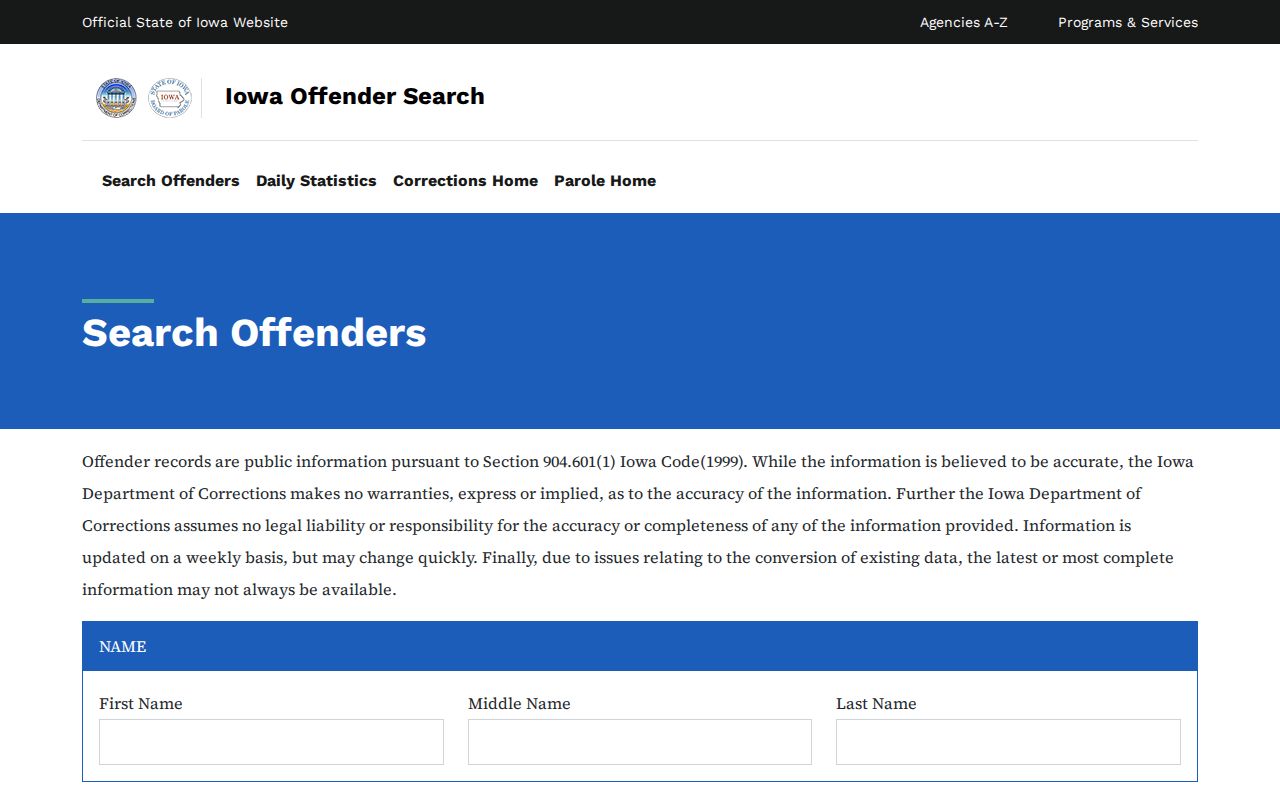
The DOC screen belongs later in the custody path, after local jail status and the court judgment have been checked.
Taylor County does publish two in-person jail visitation windows, Wednesday and Saturday from 2:00 to 4:00 p.m., and identifies Reliance Telephone as the inmate phone provider. It does not publish a verified capacity, visitor identification rule, deposit method, or release-door procedure. Those gaps are another reason to call the jail before travel and to avoid importing details from a commercial directory.
Public Access Laws
Iowa's open-records law applies to records held by local executive agencies, subject to confidential categories. Court files follow judicial access rules and specific statutes, so a sheriff request is not a substitute for asking the Taylor County clerk. DCI dissemination has its own chapter. The practical rule is simple: send the request to the office that created or holds the record.
Key statutes:
Iowa Code sections 22.2, 22.3, 22.4, and 22.7 establish access, permit reasonable actual costs, and identify confidential records and protected investigative material.
Iowa Code sections 692.2 and 692.5 govern DCI release plus subject access and challenge rights.
Iowa Code chapter 901C governs specified criminal-case expungements.
Taylor County Chapter 22 Requests
The sheriff publishes no online request portal, downloadable report form, fixed copy charge, or universal delivery time. Submit a narrow request by phone, email, fax, mail, or at the Civil Division counter. Include the event date and place, the involved agency, report number if known, the exact item sought, the desired format, and whether inspection or a copy is preferred. Ask for a cost estimate before work begins.
Chapter 22 permits reasonable actual costs. A review delay used to decide confidentiality has its own statutory reasonableness measures, but those periods are not a promise that every record will arrive by a set date. Active investigative detail, juvenile information, confidential sources, medical facts, victim-sensitive data, and personal identifiers may be withheld or redacted. If the office denies access, ask for the legal basis in writing. The Iowa Public Information Board offers guidance and a complaint process.

The board's material is the state-level resource for chapter 22 questions, while judicial files remain with the clerk.
Sealed, Expunged & Restricted
Iowa does not provide a broad process that erases every conviction. Chapter 901C covers defined outcomes and offenses. Acquittals, dismissals, successful deferred judgments, and some specified misdemeanor convictions may qualify when the statutory terms are met. Other laws cover certain alcohol-related or offense-specific records. Start with the original case number and the exact final outcome.
An expungement request for a Taylor County case is filed in Iowa District Court through the clerk. Ask for the current form and cost because a current county-specific fee was not found in the published sources. An order can restrict the court record from public inspection, but it does not mean every independently created agency document disappears for every lawful purpose. After relief, review the clerk's file and one's own DCI result. Juvenile cases, presentence reports, deferred-judgment entries, victim identifiers, and sealed files follow separate rules.
Taylor County Warrant Checks
Taylor County has no verified public active-warrant database. An unexecuted arrest or search warrant may be confidential, and absence from an online court docket does not prove that none exists. The safe chain is to call the sheriff, ask the clerk for releasable docket facts, search Iowa Courts Online for public warrant or failure-to-appear events, and confirm any recall or status with the issuing authority.
An arrest warrant directs law enforcement to take a person into custody. A bench warrant often follows a failure to appear or court-order violation. A search warrant authorizes a described search, not an arrest history report. Anyone trying to resolve their own suspected warrant should ask for verified reporting and bond instructions and may wish to consult counsel. Only the issuing court or responsible law-enforcement agency can confirm that a warrant was cleared.
Criminal Records by City in Taylor County
Taylor County's three largest incorporated cities are Bedford, Lenox, and New Market. Bedford and New Market publish no verified stand-alone police records portal, so their local criminal-record route relies heavily on the sheriff. Lenox has an identified city police function and keeps originating arrest reports, but its bookings and court files still move through county and state channels.
Bedford Criminal History
Population 1,508 · County-seat records route among City Hall, sheriff, clerk, and corrections.
Lenox Criminal History
Population 1,339 · Lenox Police originates reports; Taylor County holds booking and court records.
New Market Criminal History
Population 385 · The sheriff is the verified law-enforcement and booking route.
Taylor County Supervision Records
A Taylor County judgment can order probation, jail, or prison, but the public trail changes after sentence. The court docket is the best source for the sentence itself. Iowa DOC Search Offenders may show disclosed prison or community status. Fifth Judicial District Community-Based Corrections manages local probation and parole operations, while the Iowa Board of Parole makes release decisions.
The Fifth Judicial District page identifies the regional structure serving Taylor County.
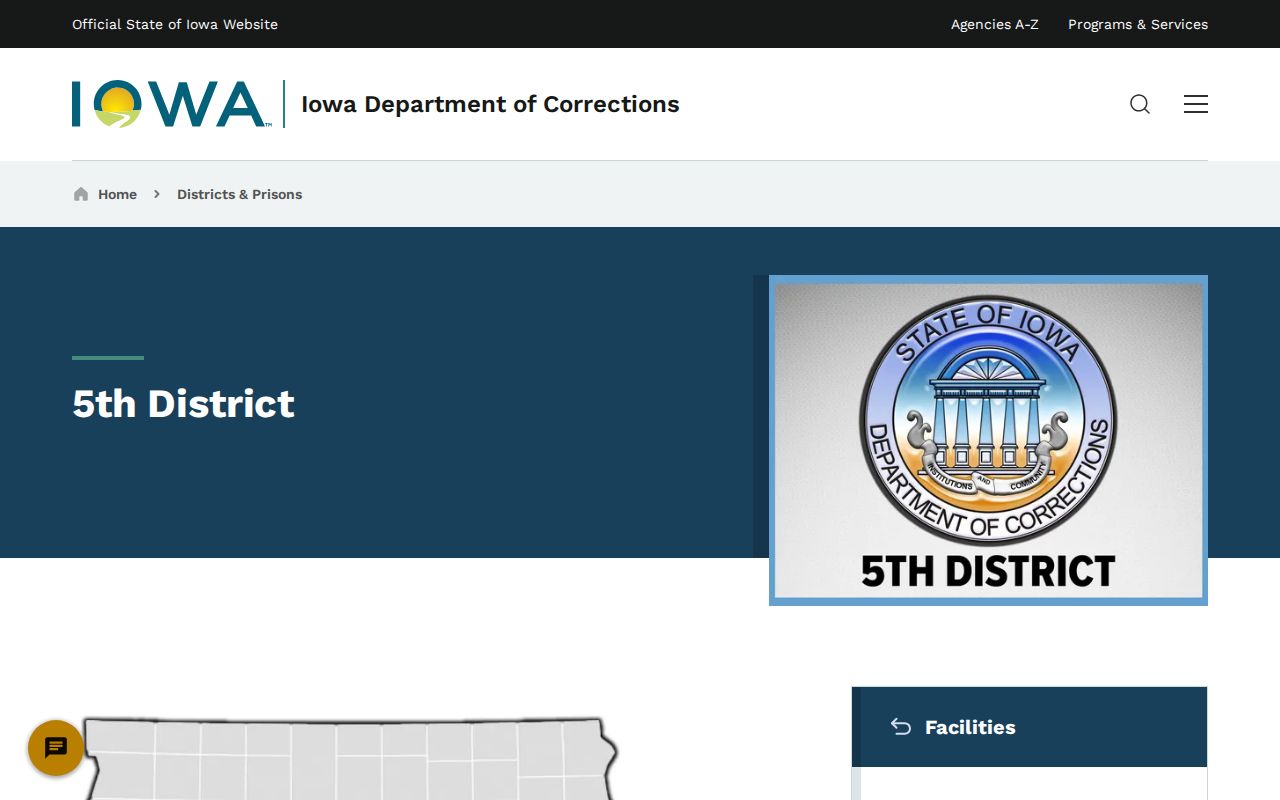
The regional page confirms where supervision is administered locally without turning private case management notes into a public dossier.
Public access stops well short of a probation officer's full working file. Presentence reports, assessments, treatment notes, home-contact details, and many supervision records are not an online Taylor County dossier. When status matters, compare the public court judgment with the DOC locator, then call the Bedford Fifth District office for the narrow fact that office is authorized to confirm. DOC warns that its public locator refreshes weekly.